|  |  |  |  |
| | |
|
Ancient Near Eastern Seals from my collection
|
|
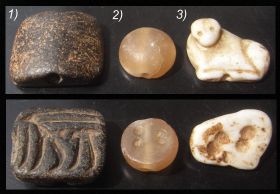
the first seals used in the Near East were stamp seals: 1) gable shaped seal, depicting a goat or an antelope, chlorite, 2.8 cm x 2.3 cm, 4th millenium B.C., Syria or Anatolia 2) calotte shaped seal, soapstone, Jemdet Nasr around 3000 B.C., 3) zoomorphic seal, marble, Jemdet Nasr around 3000 B.C.
|
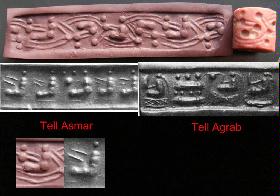
A Jemdet Nasr cylinder seal (red limestone 1.5 cm) It's from the "seated women" or "pigtailed" group. Please see references from Tell Asmar and Tell Agrab. Other parallels come from Fara, ancient Shuruppak (see Moortgat 35-37), Uruk (see Moortgat 38-39) and Susa (see Susa 719-725)
|
|
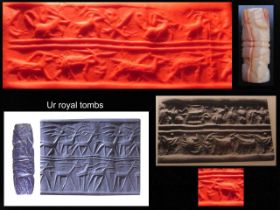
This is an Early Dynastic seal (brown veined marble, 2.7 cm) the triangular heads being typical for that period.
Seals with double registers are especially common in the period EDIIIa c. 2600-2500 B.C., see the parallel from the royal tombs at Ur. Interestingly there is a seal in the Anavian collection with a similar detail in the lower register: A goat eating from a tree, see picture.
|
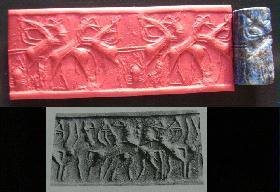
An Early Dynastic lapis lazuli cylinder seal, 2.3 cm, around 2500 B.C. Lions attacking goats, the animals crossing each other is a typical scene in this period. Note the parallel in Moortgat 1940.
|
|
|
|
| |
|  |  | |  |  |  | |
|